
When Ideology Fails
Althusser, Power, and the Third Text

“If you want new ideas, read old books”—Ivan Pavlov
Among the philosophers who unsettled the twentieth century, few left a more paradoxical legacy than Louis Althusser. To call him a madman, as some have, is to overlook the strange precision of his thought, the cold lucidity with which he dissected the very idea of ideology. His life ended in tragedy, yet his intellect redefined what it meant to think about history, power, and consciousness. That the Encyclopaedia Britannica remembers him only as someone’s teacher borders on the absurd, for Althusser stood at the very center of Europe’s postwar intellectual upheaval. From the lecture halls of the École normale supérieure to the pages of theoretical journals, his ideas radiated across philosophy, politics, and culture, shaping entire generations who absorbed his influence without ever confessing it. His project was not to overthrow Marx but to rescue him—from the faithful who had reduced his critique of capitalism to an arithmetic of production. Althusser’s Marxism was alive, relational, and restless. He stripped it of its mechanical determinism and reimagined it as a field of dynamic interactions, a system in which economic, political, and ideological forces intertwine in continual transformation rather than obeying the frozen logic of cause and effect. He defined a practice as “any process of transformation of a determinate product, affected by a determinate human labour, using determinate means (of production).” On this foundation, he proposed that society itself be understood as a network of practices—economic, political, and ideological. The economic practice converts raw material into goods, the political practice transforms social relations, and the ideological practice shapes the way people relate to the conditions of their existence. This model displaced the traditional notion of base and superstructure and replaced it with a field of relative autonomies. In Althusser’s view, the superstructure does not merely mirror the economy; it participates in sustaining it. The economy determines “in the last instance,” but that instance is never final or singular. Historical conjunctures decide which practice becomes dominant, and dominance may shift between economic, political, or ideological forms. Determination, renamed overdetermination, describes how the economic base structures the conditions under which other practices exert power.
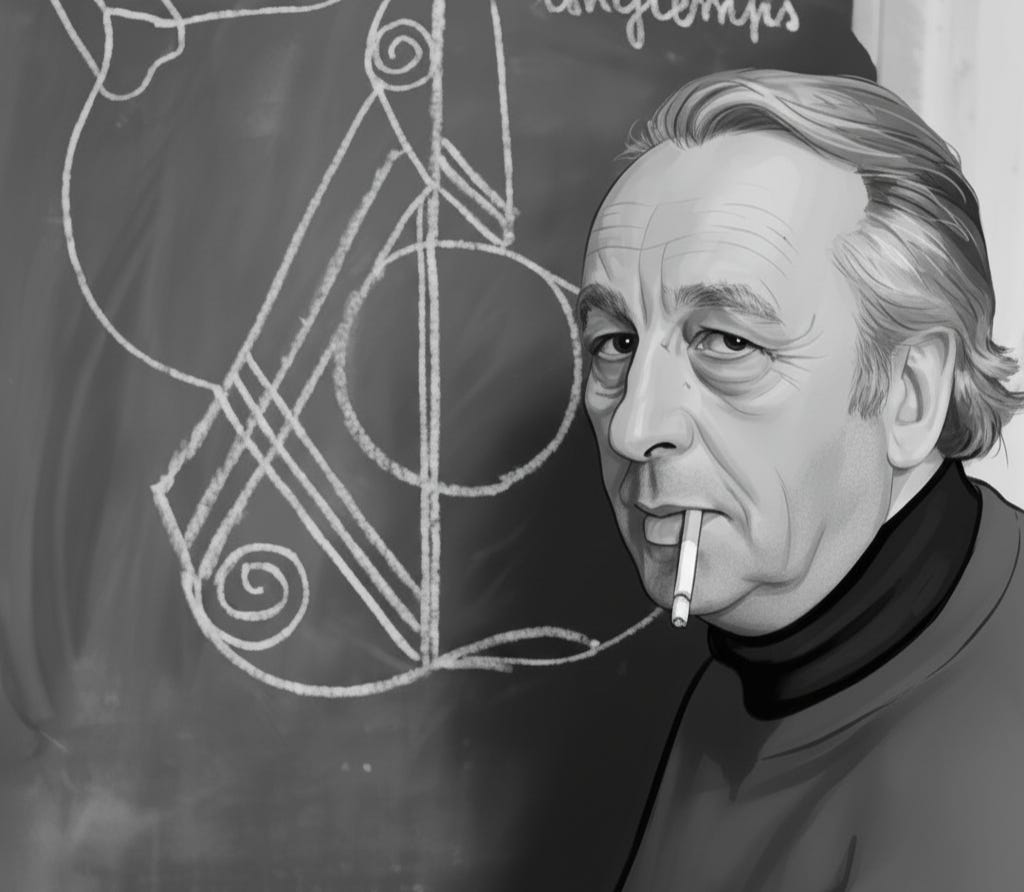
Althusser wrote that the economic is determinant not because the social formation’s political and ideological practices are mere reflections of it but because the economy determines which of those practices prevails. This dynamic picture rejects both Hegel’s notion of a unified totality and the mechanical Marxist image of a world where the economy moves the rest like a puppet. It proposes instead a complex and perpetually recalibrating arrangement of mutual influence, a world in which contradictions generate motion rather than paralysis. From this reordering of Marxism arose Althusser’s new conception of ideology. Ideology, he argued, is not simply a veil over reality but the very medium through which reality is lived. It reconciles contradictions by offering solutions that seem plausible but are in fact illusory.
“There is (harsh, conflicting) reality,” he wrote, “and the way that we represent it both to ourselves and to others.”
Ideology thus possesses both a material and representational dimension. It is not pure imagination but a lived practice that gives shape to daily existence. For ideology to function, it must never appear fallible. It cannot admit error or silence. It restricts itself to questions it can answer, constructing what Althusser described as a “fabulous, legendary, contradiction-free domain.” The result is an internally closed world that sustains itself through the exclusion of inconvenient questions. Althusser named this self-regulating structure “the problematic,” defining it as “the objective internal reference … the system of questions commanding the answers given.” The problematic determines what can be asked and what must remain unsaid, establishing the boundaries of an ideology’s discourse. What a theory or text omits, he insisted, is as significant as what it includes.
The omissions, the absences, and the silences are not voids but signals of a structure’s limit. To uncover them, the critic must perform what Althusser called a “symptomatic reading,” a process that “divulges the undivulged event in the text that it reads and, in the same movement, relates to it a different text, present, as a necessary absence, in the first.” His example was Marx’s reading of Adam Smith, which exposed within Smith’s arguments the struggle of a question that had not yet been posed. For Althusser, every text contains two texts: the manifest, which speaks, and the latent, which trembles behind it. The work of critique is to read both at once, to trace the contours of silence that reveal what the manifest text cannot say. This notion of a latent text mirrored his understanding of ideology itself. Ideology, he claimed, is not an abstract system but a practice with a material existence. It manifests in “costumes, rituals, behaviour patterns, ways of thinking.” The state preserves its order not only through force but through Ideological State Apparatuses such as religion, education, the family, politics, the media, and culture. “All ideology,” he declared, “has the function (which defines it) of ‘constructing’ concrete individuals as subjects.” This construction occurs through “hailing” or “interpellation,” acts that call to individuals and compel them to recognize themselves as subjects. The advertisement that says “People like you buy this” is the clearest example. It hails both the individual “you” and the collective “people like you.” The viewer identifies with that imagined position and becomes the subject of the message. The identity thus created is an illusion, a misrecognition, because the “you” exists only within the ideological apparatus that produced it. Through such interpellations, individuals are bound to material practices: they become consumers, believers, patriots, or citizens. Ideology, in this sense, is a machinery of participation, a system that recruits and reproduces subjects who enact its logic.
Yet Althusser’s theory, brilliant as it is, falters at its limits. He assumed that ideology functions flawlessly, reproducing subjects with mechanical efficiency. His account left no room for failure, contradiction, or resistance. The questions he did not ask are the ones that expose his framework’s most revealing silences. What do ideologies seek beyond reproduction? What happens when multiple ideologies compete for the same subjects? Althusser’s model of manifest and latent texts implies that meaning arises from the tension between what is said and what is unsaid. But how are we to know that the latent text we reconstruct is the correct one? To compare the latent text to the manifest text from which it is derived is to enter a circle. A text cannot validate its own hidden meaning without dissolving into tautology. The logic demands a third point of reference, a “master-text,” complete and universal, that contains both the manifest and the latent. Such a text would be the total library of meaning, encompassing all possible articulations, their presences and absences alike. The historical moment would determine which portions become visible and which remain hidden. This “Third Text,” as one might call it, is nothing other than the human psyche. Each person carries within them a vast archive of potential meanings, most of them inaccessible to consciousness. When we encounter a text or an ideology, we compare it, often unconsciously, to this internal library. The manifest text acts as a stimulus, summoning fragments of the Third Text and generating latent meanings through the act of comparison. The psyche thus becomes both the reader and the repository of ideology. Nature offers a striking analogy: DNA operates as such a master text, containing within it every genetic possibility, some expressed, others dormant, each awaiting the proper environmental signal. The psyche functions similarly. It is complete in its totality yet mutable in its manifestations. The text of the self does not change, but different parts of it are activated in response to new stimuli. Reading, then, is always a process of comparison between the external and the internal, between the manifest and the Third Text. To read is to deconstruct. One need not be a trained Althusserian critic to perform this act, for every reader inevitably measures what they encounter against their own internal text. The generation of latent meaning is the natural consequence of understanding itself. This is why interpellations can fail. Every subject, when addressed by ideology, performs this act of comparison. The success of interpellation depends on the alignment between the ideology’s message and the latent meaning generated in the reader’s psyche. Because the psyche contains all possible meanings, individuals are susceptible to countless and often competing interpellations. The modern world, saturated with information, presents a constant chorus of ideological appeals. Advertising, religion, politics, media, and culture all hail us at once, each claiming our attention, each seeking to define our subjectivity. Even within the most authoritarian systems, ideologies are plural. The party, the church, the family, the army, and the media each project their own calls, sometimes in harmony, often in discord. To imagine that people respond to them sequentially, one at a time, is to deny the simultaneity of modern experience. The subject lives in a field of competing interpellations, continually negotiating among them. Yet identifying how ideologies function does not explain why they do so. Althusser’s system lacks an account of motive. Advertising, for instance, interpellates subjects to consume, but consumption itself is a means, not an end. Religion hails believers to pray, but prayer serves something deeper. In every case, behind the material practice lies a psychological one. What ideologies seek, finally, is power—the capacity to interpellate, to command attention, to shape perception. The businessman who sells, the priest who preaches, the politician who persuades all pursue the same ultimate object: influence over other minds. Their methods differ, their symbols vary, but their desire is identical. Each uses material or spiritual currency to sustain its ability to hail and to be heard. Interpellation becomes both the technique and the reward of power. Ideologies hail in order to secure the means to continue hailing. This circularity, which Althusser’s theory reveals but does not resolve, mirrors the circularity of social life itself. The reproduction of power requires the reproduction of subjects, and the reproduction of subjects sustains power. Althusser’s system is therefore both profound and self-consuming. It explains how ideology perpetuates itself but cannot explain why the cycle should ever cease. Yet in exposing the machinery of ideology, he provides the tools for its critique. Once we recognize that every message hails us, we can begin to choose how to answer. The act of awareness interrupts the automatic process of interpellation. To hear the call of ideology and to pause before replying is, in a small but real sense, to be free. The space between the manifest and the latent, between the text and the Third Text, becomes the margin where thought reclaims its independence. In that brief interval of recognition, where we become aware of being addressed, the machinery falters. Power depends on obedience, and obedience depends on unconsciousness. Consciousness, even fleeting, is resistance. This, perhaps, is the hidden moral of Althusser’s madness: that to see the world as a system of competing interpellations is not to surrender to cynicism but to recover the possibility of choice. His work endures not as dogma but as a mirror held to the machinery of belief, showing us the endless conversations between our own Third Text and the voices that seek to define it.
“To hear the call of ideology and to pause before replying is, in a small but real sense, to be free.”
Beautifully said. Thank you for laying out Althusser’s ideas, and their limits, with such clarity. You’ve introduced me to a concept I hadn’t encountered before: interpellation. I’ll be spending my next hour reading more about it and I love that!